The Best of Two World Power & Precision ECO is the successor of our Best of Two Worlds Solution upgrade. For the BOTW P&P ECO we have applied a large number of innovative techniques in order to improve the sound quality of your M2TECH Young (DSD) to a much higher level compared to a conventional linear audio power supply. Hi As below in quotes from emails sent to Marco at M2Tech I have recently purchased a PC with Windows 7 64-bit to replace my aging Mac Mini G4 with OSX10.5 and HP Pavillion laptop with Windows XP, both of which worked fine with my best-yet sounding USB-SPDIF converter, an original Hiface with AQV. The newest M2Tech DAC (named after one of our favorite rockers who adores analog sound) is at the top of the list of computer-audiophile-approved DACs. So don’t get drawn in just by the cool, blue lights. Let the sound of the Young DAC impress on its own. The M2Tech HiFace is significantly more musical sounding than the ODAC with a rich, full and warmer sound. If only they would work on the build quality. Call me crazy, but I like my DACs to look just as good as they sound. That's the reason I'm docking one star!
February 2010
World Premiere!
Enjoy the Music.com Award of Excellence
M2Tech hiFace 24-bit/192kHz USB Digital Audio Interface
A journey into the world of PC audio.
Review By Mike Galusha
Click here to e-mail reviewer
I built my first dedicated audio PCin about 2001 and until now I was never happy enough with the results to keep aPC source in my system. During this time I have tried various sound cards andUSB devices and ultimately ended up using a highly modified Squeezebox as Ipreferred that over a Parts Connexion modified Denon 2900 and the various PCbased sources. Over the years I have modified the Squeezebox repeatedly until itfinally ended up with a vacuum tube output stage and 5 discrete power suppliesfor the various parts of the circuit. The result was and is very satisfying butthe lack of high resolution playback has bothered me for a while, especiallywith the increased availability of 24-bit/96kHz downloads.
There are several high end sound cards such asthe Lynx L22 or the ESIJuli@ that will provide this capability but using one ofthese means a full size PC with an available PCI or PCI Express slot.Unfortunately building a truly silent PC is not a trivial task because of thecooling requirements. There are ways to do this but inevitably this becomes anexpensive project and essentially out of my budget.
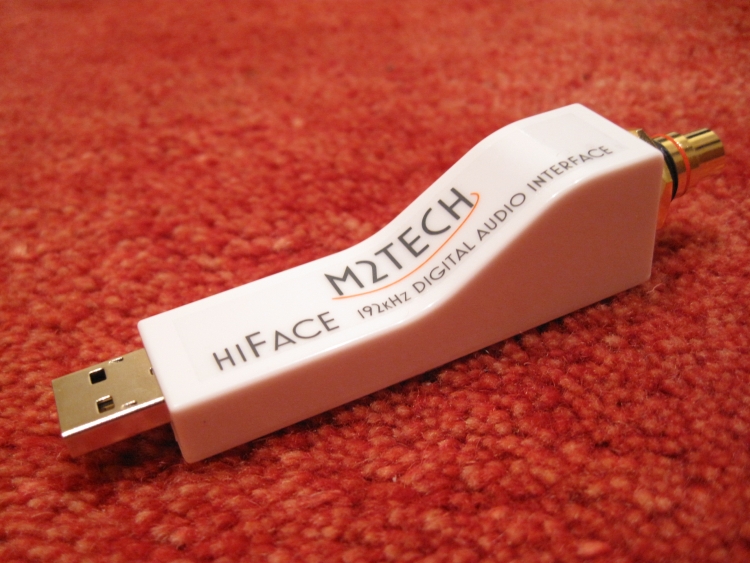
Enter the M2Tech hiFace USB S/PDIF Output interface. Thisnifty little device will allow output of up to 24-bit/192kHz S/PDIF from a USBport. The hiFace looks a bit like an oversize USB flash drive with an RCA or BNCconnector on the opposite end.Using a USB device allowsone to employ a much smaller and easier to cool computer and I ended up with a'nettop' class of machine. This is much like the netbook laptops usingan Intel Atom processor and a 2.5-inch hard drive. Passive heat sinks are enoughto provide cooling without fans and the small hard drive is very quiet andinaudible from my listening position, avoiding the expense of a solid statedrive. Unfortunately most of the USB devices, either DAC or S/PDIF output do notsupport the highest resolutions available and often use the PCM2702 from TexasInstruments, which is limited to 16-bit/48kHz. There are some very nice USB DACsavailable from Ayre Acoustics and Wavelength Audio to name a few but for the lowbudget audiophile like myself they are still a stretch of the wallet.

The M2Tech hiFace operates asynchronously with two highprecision clocks covering the multiples of 44.1/88.2/176.4kHz and 48/96/192kHz.These clocks have a claimed precision of 2.5 ppm and very low phase noise. Theuse of a high performance transmitter allows the output to have extremely lowjitter and M2Tech employs a pulse transformer to provide galvanic isolation fromthe computer.At this time M2Tech offers drivers for boththe Macintosh and Windows operating systems. Linux support is forthcoming. Sincemy day job is working with Windows based machines I don't have any experiencewith the Macintosh version and look forward to giving it a go under Linux oncethe drivers are available.
With the hardware issues addressed that leaves the integrationwith your computer. Unfortunately use on a computer with the Windows operatingsystem introduces problems, the main being the kernel mixer, also known asKMixer. This bit of software resamples the audio data after the playbackapplication and generally ensures non bit perfect playback, so the data going toyour hardware is not the same as the data from the file. Obviously this is notgood; fortunately there are ways around this. On XP systems ASIO (Audio StreamInput / Output) has been developed and is supported by a number of vendors.There is another method known as kernel streaming, this takes advantage of aWindows API that allows real time streaming to audio and video devices. It issupported in some music players, usually via a plug in. Windows Vista andWindows 7 have a new piece of software called WASAPI, this stands for WindowsAudio Session API and does contain a mode to allow direct streaming of audiodata to the playback devices, bypassing all the mixing functions. Kernelstreaming will also work under Vista and Windows 7.
The hiFace is primarily designed to use kernel streaming underWindows, regardless of version. This ensures low CPU utilization even at highbit depth and sampling rates and allows for a highly optimized driver. M2Techsupplies proprietary drivers for the device since it does not support the usualplug and play USB audio device protocol. A player supporting kernel streaming isrequired to take full advantage of the hiFace. Such players include foobar 2000,Winamp and Media Monkey. I have been using foobar with great success.
Not only that, the sound quality of the Benchmark was better than excellent, and it blows away the ADC that was contained within my multipurpose sound card. Upon receiving the more expensive, higher resolution M2Tech Joplin under review, I was excited to again archive some records, anticipating even better sound quality.
While getting all the parts to work together is not terriblydifficult for the PC savvy, it can be a daunting task for those with littlecomputer knowledge, especially if your music files are stored on a remote systemsuch as a NAS device. Fortunately M2Tech has a fairly extensive FAQ on their website as does the US distributor. The distributor for your country may havehelpful information available, it would be worth checking.
Enough BlahBlah About PC Audio
How Does It Perform?
The short answer is incredibly well, at leastin my system. In the last couple of months I completed building two DACs basedon the ESS ES9018 Sabre32 DAC chip. These started life as the first generation'Buffalo DAC' kits from Twisted Pear audio. They sat on a shelf formany months before I finally had a chance to do something with them. In the timesince they were originally acquired ESS released the ES9018 32 bit chip and itturned out these were pin compatible with the original ES9008 chip, some huntingturned up a source for the new chips. I transplanted the DAC chips and set aboutbuilding a pair of DAC's, one for myself and one for a buddy. The one for myfriend sports a tube output stage with 12B4 triodes and Gary Pimm's CCS moduleswith the output coming off the mu follower connection. This allows for a veryquiet output stage to take advantage of the stellar noise specs of the Sabre32chip. Dedicated power supplies were built for the analog, digital and clocksections. The one I built for myself is the same except for the use oftransformers on the output. I mention all this because one of the features ofthe ESS Sabre32 chip is the use of a 'Patented Time Domain JitterEliminator' offering the benefit of 'Unmatched audio clarity free frominput clock jitter'. In my mind this means that a DAC built with this chipshould be very insensitive to the S/PDIF source.
My listening sessions were surprising; I did not expect tofind much if any difference using various S/PDIF sources and was mainly lookingfor the ability to play high resolution files. I tried a small variety oftransport mechanisms with both DAC's and all sounded somewhat different. Allwere good but the M2Tech hiFace won the day on both standard Red Book CD andhigh resolution data at 24-bit/96kHz and higher. The sources I had availablewere the S/PDIF output on my Squeezebox, a Logitech Transporter (via BNC output)and my PCX modified Denon 2900 universal player. The Denon has an LC AudioLClock XO 3, which should allow it to provide a high quality S/PDIF output. Ialso compared two versions of the hiFace, one with the standard RCA jack and onewith the optional BNC jack to provide a true 75 Ohm connection.
Over a period of several weeks I listened to a variety of bothhigh resolution and standard audio via all the sources, creating a DVD-Audiodisc of the same tracks to play in the Denon and of course ensuring it was setto not re-sample the audio going to the S/PDIF output. For all listening I useda cable made from Belden 1505 coax with 75 Ohm BNC connectors. The DACs werebuilt with very high quality 75 ohm jacks and used RG179 coax from the jack tothe board, terminated carefully to keep unshielded portions to a minimum. Forthe RCA output sources I used a BNC -> RCA adapter that came with a Stereovoxcable.
My order of preference from least to most is the Denon 2900,modified Squeezebox, Logitech Transporter, hiFace RCA version and finally thehiFace BNC version. I was surprised the hot-rodded Denon did not fare better asa transport but my notes place it firmly at the bottom of my available sources.I keep it only because I have 60 odd SACDs, which of course I cannot play viaany of the other methods. The Transporter was fairly close in performance to thehiFace but the bass was muddier and high frequencies such as triangle andcymbals had a kind of extra splash to them that just didn't seem as natural asthe hiFace. The presentation was also more forward and aggressive, which is theonly term that really seems appropriate.
Thedifferences between the hiFace's were subtle but the BNC output resulted in morelow level detail and greater sense of air and space. The BNC version seemed topresent more information but was simultaneously more relaxed. I suspect this isdue to a more accurate transmission of the signal since there is no impedancemismatch from the RCA plug as there are no internal differences between the RCAand BNC versions. The overall sound of the hiFace/Sabre32 DAC combo is somethingquite special, especially when playing high resolution recordings. While RedBook recordings are reproduced in an exemplary fashion, queuing up a24-bit/96kHz album such as those from HD Tracks just lends a naturalness andease to the music along with more ambiance and other low level detail cues. TheHRx releases from Reference Recordings are truly stunning and in my mind definewhat is possible. Listening to the HRx discs I can't do anything except listen,I am just sucked into the music and all the typical audiophile jargon no longerapplies, the music is just so alive and present that it demands your fullattention. When the kids asked what I wanted for Christmas it was easy, more HRxdiscs. It's a good thing the hiFace is not expensive, that leaves more money tospend on hi-res music.
In the interest of full disclosure, the US Distributor forM2Tech is a friend but I purchased three of the hiFace devices for my personaluse. Steven contacted me several weeks later and asked if I'd be willing toreview them, so the units reviewed are mine and not on loan. I don't see aconflict of interest but I wanted to be sure everything was transparent in caseothers might question this.
The curious reader might ask, why three of them? Easy, one formy dedicated system, one for work and one to hack, but that's another story...
Current SystemConfiguration
Source is the hiFace feeding my DIY Sabre32 DAC
Preamplifier is a DIY design using a 6SN7 gain stage, PimmCCS, Pimm/Swenson regulator and all film capacitors.
Amplification is either Consonance Cyber 845 SET or McIntoshMC275 running full differential via Lundahl transformers.
Speakers are GedLee Abbeys with three GR Research/RhytmikAudio servo subs.
Power and speaker cables are Kaplan Cable GS.
Interconnects are a combination of a DIY design using Neotechsolid silver and some milspec 26ga x 3 shielded Teflon for the balanced runs.
Dedicated20 Ampere circuits with Jena Labs cryo outlets and 2 BPT 2.5 Ultra balancedpower conditioners.hiFace DAC
A great sounding DAC for budget-conscious hi-fi systems
The hiFace DAC is a high value-for-money ratio Digital-to-Analog Converter to turn your computer into the main audio source for your hi-fi system.
Just plug it into one of your computer’s USB ports and connect its output to your hi-fi system: you’ll be able to listen to music files with a very high sound quality, be they MP3, CD quality or high resolution files.
M2tech Sound Cards For Teens
Extremely easy to use, it’s seen by your computer as an audio card. No need for driver with Mac and Linux computers, the driver for Windows is provided.
Do you want to buy this product? Visit our on-line shop or contact your local distributor.
hiFace DAC works great together with…
Your hi-fi system
The hiFace DAC is a complete conversion system, therefore you only need your computer and your hi-fi system.
A PC or a Smartphone and a Pair of Active Speakers
This is the simplest setup, which can deliver stunning sound if the speakers are good quality ones.
A Smartphone and Headphones
The hiFace DAC is not designed to drive headphones. But when your headphones have high sensitivity and high impedance, then you can plug them directly into the hiFace DAC’s output.
Specifications
M2tech Sound Cards For Kids
Inputs: | USB 2.0 high speed |
Outputs: | analog single-ended (3.5mm stereo jack) |
Sample frequencies: | PCM 44.1kHz to 384kHz |
PCM resolution: | 16 bits to 32 bits |
Signal-to-Noise Ratio: | 112dBA |
THD+N: | 0.005% @ 2Vrms out |
Output Voltage: | 2Vrms (47 kOhms load) |
Output impedance: | 470 Ohms |
Supply voltage: | 5VDC (USB powered) |
Current Consumption: | 300mA |
Size: | 80x15x10mm (wxdxh) |
Weight: | net 25g gross 75g |